> ## Documentation Index
> Fetch the complete documentation index at: https://docs.unify.ai/llms.txt
> Use this file to discover all available pages before exploring further.
# Architecture
> How the Google Workspace / Microsoft 365 integration actually works in the open-source unify repo
Everything in the [Workspace section](/workspace/overview) is implemented in
the open-source [`unifyai/unify`](https://github.com/unifyai/unify)
repository. This developer sub-section explains how it *actually works* —
the modules, classes, and contracts — for anyone reading, extending, or
self-hosting the code.
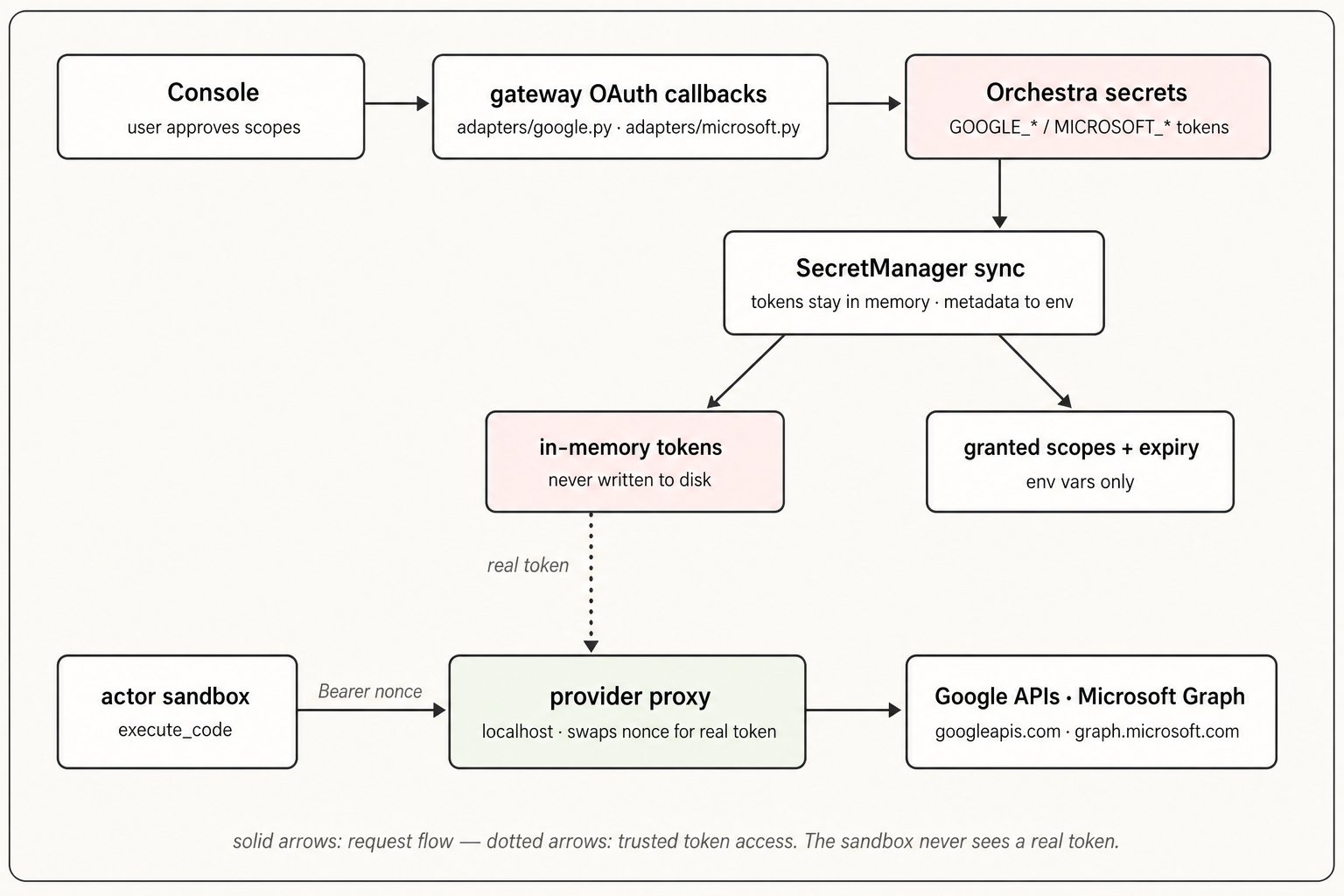
The workspace integration is built from four cooperating pieces:
1. **Gateway OAuth adapters** —
[`unify/gateway/adapters/google.py`](https://github.com/unifyai/unify/blob/main/unify/gateway/adapters/google.py)
and
[`unify/gateway/adapters/microsoft.py`](https://github.com/unifyai/unify/blob/main/unify/gateway/adapters/microsoft.py)
— handle the OAuth callbacks when a user connects an account, exchange
the authorization code for tokens, and persist them as assistant
secrets.
2. **Runtime token plumbing** —
[`unify/common/runtime_oauth.py`](https://github.com/unifyai/unify/blob/main/unify/common/runtime_oauth.py)
plus the OAuth-aware parts of
[`unify/secret_manager/secret_manager.py`](https://github.com/unifyai/unify/blob/main/unify/secret_manager/secret_manager.py)
— mirror tokens into the running assistant and keep raw credentials out
of everything the LLM can read.
3. **The provider proxy** —
[`unify/provider_proxy/`](https://github.com/unifyai/unify/tree/main/unify/provider_proxy)
— a localhost proxy that gives sandboxed actor code the *full* Google /
Microsoft Graph REST surface without ever holding a real token, while
enforcing the per-assistant file-access allowlist.
4. **Workspace surfaces** — the trusted
[`unify/workspace_email/`](https://github.com/unifyai/unify/tree/main/unify/workspace_email)
primitive for the connected mailbox, and the gateway channels
([`gmail`](https://github.com/unifyai/unify/blob/main/unify/gateway/channels/gmail/views.py),
[`outlook`](https://github.com/unifyai/unify/blob/main/unify/gateway/channels/outlook/views.py),
[`drive`](https://github.com/unifyai/unify/blob/main/unify/gateway/channels/drive/views.py),
[`sharepoint`](https://github.com/unifyai/unify/blob/main/unify/gateway/channels/sharepoint/views.py))
that back sending, inbox watches, and the Console file picker.
 ## The core design decision
One idea organizes the whole subsystem: **the LLM-controlled sandbox never
holds a real OAuth token**. Sandboxed `execute_code` calls
`get_oauth_access_token("google")` and receives a **nonce** — a capability
handle valid only against the localhost proxy. The proxy, running in the
trusted parent process, swaps the nonce for the real bearer token on each
upstream request. Two consequences fall out of this:
* Actor code gets the *entire* provider REST API (Drive, Calendar, Gmail
API, Graph) with ordinary `httpx` calls — no bespoke per-endpoint tool
surface to maintain.
* Every file-shaped request funnels through one choke point where the
[workspace file-access policy](/workspace/files) is enforced, uniformly,
regardless of what code the LLM wrote.
Trusted, non-sandboxed code (like `WorkspaceEmailManager`) bypasses the
proxy and uses `get_provider_access_token`, which returns the real token —
the split between those two functions in `runtime_oauth.py` *is* the trust
boundary.
## End-to-end lifecycle
1. **Connect** — the Console builds an OAuth URL (scope bundles are
assembled in the hosted control plane; see [the scopes
note](/workspace/developers/gateway-channels#oauth-scopes)) and the user
consents at Google/Microsoft. The provider redirects to
`GET /google/auth/callback` or `GET /microsoft/auth/callback` on the
gateway.
2. **Persist** — the callback (`google_oauth_callback` /
`microsoft_oauth_callback`) validates the HMAC-signed `state` via
`verify_oauth_state` in
[`unify/gateway/adapters/oauth.py`](https://github.com/unifyai/unify/blob/main/unify/gateway/adapters/oauth.py),
exchanges the code, and writes the token set to Orchestra with
`upsert_assistant_secrets`: `GOOGLE_ACCESS_TOKEN`,
`GOOGLE_REFRESH_TOKEN`, `GOOGLE_TOKEN_EXPIRES_AT`,
`GOOGLE_GRANTED_SCOPES`, `GOOGLE_ACCOUNT_EMAIL` (and the `MICROSOFT_*`
equivalents, plus `MICROSOFT_TOKEN_SOURCE`).
3. **Mirror** — the running assistant pulls secrets back down through
`SecretManager._sync_assistant_secrets`, with a hard split: raw tokens
stay in an in-memory dict, while non-sensitive metadata (expiry,
granted scopes) is mirrored to the environment. Details in
[OAuth & secrets](/workspace/developers/oauth-and-secrets).
4. **Use** — actor code hits the proxy
([Provider proxy](/workspace/developers/provider-proxy)); trusted
surfaces like `primitives.workspace_email.*` call providers directly
([Email & gateway channels](/workspace/developers/gateway-channels)).
5. **Refresh** — the runtime never talks to Google/Microsoft token
endpoints itself. A platform refresh job keeps Orchestra's copies fresh;
the runtime re-syncs on demand (`refresh_provider_access_token`) — for
example after the proxy sees a 401.
6. **Revoke** — disconnecting calls `POST /google/revoke` (Google tokens
are actively revoked upstream) and clears the Orchestra secrets; the
next sync drops them from the runtime.
## What lives where
| Concern | Open-source `unify` | Hosted control plane (closed) |
| ---------------------------------------- | ---------------------------------------------------------------- | -------------------------------------------------- |
| OAuth callbacks, token exchange | `unify/gateway/adapters/{google,microsoft,oauth}.py` | — |
| Scope bundles (feature → scopes) | consumed, not defined | `unify-deploy/common/scopes.py` + Orchestra mirror |
| Token storage of record | — | Orchestra assistant secrets |
| Token refresh cron, watch renewal | — | hosted scheduled jobs |
| Runtime token access + sandbox isolation | `unify/common/runtime_oauth.py`, `unify/provider_proxy/` | — |
| Connected-mailbox primitive | `unify/workspace_email/` | — |
| Send / watch / picker endpoints | `unify/gateway/channels/{gmail,outlook,email,drive,sharepoint}/` | mounted by the hosted comms app |
| File-access policy storage | mirrored into `PolicyStore` | Orchestra `workspace-file-access` config |
The rest of this sub-section walks each layer in depth:
Token plumbing, the split storage model, and sandbox isolation.
Request classification, the file-access policy engine, and response
filtering.
WorkspaceEmailManager, the Gmail/Outlook channels, watches, and the
Drive/SharePoint pickers.
## The core design decision
One idea organizes the whole subsystem: **the LLM-controlled sandbox never
holds a real OAuth token**. Sandboxed `execute_code` calls
`get_oauth_access_token("google")` and receives a **nonce** — a capability
handle valid only against the localhost proxy. The proxy, running in the
trusted parent process, swaps the nonce for the real bearer token on each
upstream request. Two consequences fall out of this:
* Actor code gets the *entire* provider REST API (Drive, Calendar, Gmail
API, Graph) with ordinary `httpx` calls — no bespoke per-endpoint tool
surface to maintain.
* Every file-shaped request funnels through one choke point where the
[workspace file-access policy](/workspace/files) is enforced, uniformly,
regardless of what code the LLM wrote.
Trusted, non-sandboxed code (like `WorkspaceEmailManager`) bypasses the
proxy and uses `get_provider_access_token`, which returns the real token —
the split between those two functions in `runtime_oauth.py` *is* the trust
boundary.
## End-to-end lifecycle
1. **Connect** — the Console builds an OAuth URL (scope bundles are
assembled in the hosted control plane; see [the scopes
note](/workspace/developers/gateway-channels#oauth-scopes)) and the user
consents at Google/Microsoft. The provider redirects to
`GET /google/auth/callback` or `GET /microsoft/auth/callback` on the
gateway.
2. **Persist** — the callback (`google_oauth_callback` /
`microsoft_oauth_callback`) validates the HMAC-signed `state` via
`verify_oauth_state` in
[`unify/gateway/adapters/oauth.py`](https://github.com/unifyai/unify/blob/main/unify/gateway/adapters/oauth.py),
exchanges the code, and writes the token set to Orchestra with
`upsert_assistant_secrets`: `GOOGLE_ACCESS_TOKEN`,
`GOOGLE_REFRESH_TOKEN`, `GOOGLE_TOKEN_EXPIRES_AT`,
`GOOGLE_GRANTED_SCOPES`, `GOOGLE_ACCOUNT_EMAIL` (and the `MICROSOFT_*`
equivalents, plus `MICROSOFT_TOKEN_SOURCE`).
3. **Mirror** — the running assistant pulls secrets back down through
`SecretManager._sync_assistant_secrets`, with a hard split: raw tokens
stay in an in-memory dict, while non-sensitive metadata (expiry,
granted scopes) is mirrored to the environment. Details in
[OAuth & secrets](/workspace/developers/oauth-and-secrets).
4. **Use** — actor code hits the proxy
([Provider proxy](/workspace/developers/provider-proxy)); trusted
surfaces like `primitives.workspace_email.*` call providers directly
([Email & gateway channels](/workspace/developers/gateway-channels)).
5. **Refresh** — the runtime never talks to Google/Microsoft token
endpoints itself. A platform refresh job keeps Orchestra's copies fresh;
the runtime re-syncs on demand (`refresh_provider_access_token`) — for
example after the proxy sees a 401.
6. **Revoke** — disconnecting calls `POST /google/revoke` (Google tokens
are actively revoked upstream) and clears the Orchestra secrets; the
next sync drops them from the runtime.
## What lives where
| Concern | Open-source `unify` | Hosted control plane (closed) |
| ---------------------------------------- | ---------------------------------------------------------------- | -------------------------------------------------- |
| OAuth callbacks, token exchange | `unify/gateway/adapters/{google,microsoft,oauth}.py` | — |
| Scope bundles (feature → scopes) | consumed, not defined | `unify-deploy/common/scopes.py` + Orchestra mirror |
| Token storage of record | — | Orchestra assistant secrets |
| Token refresh cron, watch renewal | — | hosted scheduled jobs |
| Runtime token access + sandbox isolation | `unify/common/runtime_oauth.py`, `unify/provider_proxy/` | — |
| Connected-mailbox primitive | `unify/workspace_email/` | — |
| Send / watch / picker endpoints | `unify/gateway/channels/{gmail,outlook,email,drive,sharepoint}/` | mounted by the hosted comms app |
| File-access policy storage | mirrored into `PolicyStore` | Orchestra `workspace-file-access` config |
The rest of this sub-section walks each layer in depth:
Token plumbing, the split storage model, and sandbox isolation.
Request classification, the file-access policy engine, and response
filtering.
WorkspaceEmailManager, the Gmail/Outlook channels, watches, and the
Drive/SharePoint pickers.