> ## Documentation Index
> Fetch the complete documentation index at: https://docs.unify.ai/llms.txt
> Use this file to discover all available pages before exploring further.
# Task system internals
> How the task system actually works — a code-level tour of the open-source runtime
Everything in this section so far describes tasks as a user experiences
them. This page is for developers: how tasks are modeled, scheduled,
activated, executed, and certified inside the open-source
[`unifyai/unify`](https://github.com/unifyai/unify) runtime. The heart of it
is the
[`unify/task_scheduler`](https://github.com/unifyai/unify/tree/main/unify/task_scheduler)
package — start with its
[README](https://github.com/unifyai/unify/blob/main/unify/task_scheduler/README.md),
which this page expands on.
Three design commitments shape everything below:
1. **Tasks are rows, not processes.** A task is a durable record in a
storage context; execution is something that *happens to* the row, and
every lifecycle transition is a field update you can inspect.
2. **Tasks are independent.** There is no queue and no chaining between
tasks — each fires on its own clock or trigger, and concurrent runs are
normal.
3. **The description is the program** (by default). Unless a task has been
promoted to a certified symbolic entrypoint, execution means handing the
task's natural-language `description` to the actor.
## The task model
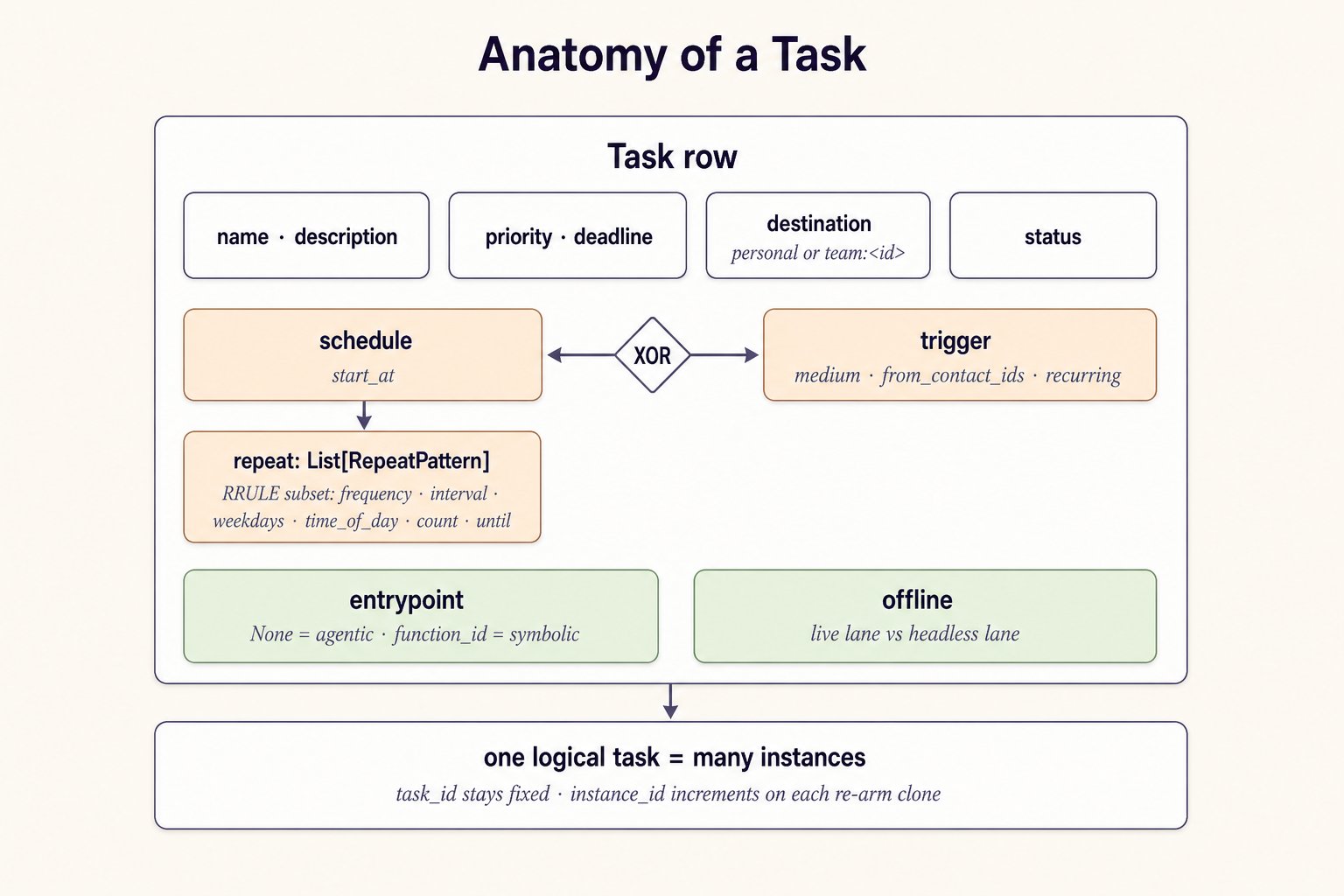 The model lives in
[`unify/task_scheduler/types/task.py`](https://github.com/unifyai/unify/blob/main/unify/task_scheduler/types/task.py).
`TaskBase` is the writable payload; `Task` adds identity:
| Field | Meaning |
| ---------------------- | --------------------------------------------------------------------------------------------------------------------------------------------------------------------------------------------------------- |
| `name`, `description` | Title and the detailed instruction. For agentic tasks the description **is** what gets executed. |
| `status` | Lifecycle state — see the state machine below. |
| `schedule` | Optional [`Schedule`](https://github.com/unifyai/unify/blob/main/unify/task_scheduler/types/schedule.py) holding `start_at`. |
| `trigger` | Optional [`Trigger`](https://github.com/unifyai/unify/blob/main/unify/task_scheduler/types/trigger.py) — an inbound communication event that starts the task. |
| `repeat` | Optional list of [`RepeatPattern`](https://github.com/unifyai/unify/blob/main/unify/task_scheduler/types/repetition.py)s. |
| `priority`, `deadline` | [`Priority`](https://github.com/unifyai/unify/blob/main/unify/task_scheduler/types/priority.py) (`low`→`urgent`) and an optional due-by datetime — distinct from `start_at`, which is when work *begins*. |
| `destination` | Where the row lives: personal by default, or a shared team pool via `team:` (see [storage](#storage-and-team-routing)). |
| `response_policy` | Freeform contact-handling policy for the run; overrides contact-level policies where they conflict. |
| `entrypoint` | `None` = **agentic** execution; a `function_id` = **symbolic** execution via a stored function (see [certification](#symbolic-entrypoints-and-offline-certification)). |
| `offline` | Delivery lane only — `True` runs in the headless lane without waking a live session. Orthogonal to agentic/symbolic. |
| `activated_by` | [`ActivatedBy`](https://github.com/unifyai/unify/blob/main/unify/task_scheduler/types/activated_by.py) (`schedule` / `trigger` / `explicit`) — set automatically at activation, never directly editable. |
| `info` | Execution summary written on completion. |
Two invariants matter constantly:
* **Schedule XOR trigger.** A model validator rejects any row with both:
*"A task cannot have both schedule and trigger."* A task either fires on
the clock or fires on an event, never both.
* **`task_id` vs `instance_id`.** One logical task can execute many times.
The `task_id` is stable; each re-arm clones a fresh row with the next
`instance_id`. "The weekly recap" is one `task_id` with a growing family
of instances, each with its own status and history.
### Recurrence: a typed RRULE subset
[`repetition.py`](https://github.com/unifyai/unify/blob/main/unify/task_scheduler/types/repetition.py)
defines `RepeatPattern` as "a small subset of RFC-5545 RRULE expressed as
first-class fields": `frequency` (`MINUTELY` through `YEARLY`), `interval`,
`weekdays` (valid only with weekly frequency — a validator enforces it),
`time_of_day`, and the two terminators `count` and `until`. Two functions do
the real work:
* `normalize_repeat_patterns` collapses evenly-spaced daily slot lists into
a single minutely rule.
* `next_repeated_start_at(previous_start, patterns, current_occurrence_index, now)`
computes the earliest future occurrence, honoring `count`/`until` — this
is what re-arm cloning calls to schedule the next instance.
## The lifecycle
The model lives in
[`unify/task_scheduler/types/task.py`](https://github.com/unifyai/unify/blob/main/unify/task_scheduler/types/task.py).
`TaskBase` is the writable payload; `Task` adds identity:
| Field | Meaning |
| ---------------------- | --------------------------------------------------------------------------------------------------------------------------------------------------------------------------------------------------------- |
| `name`, `description` | Title and the detailed instruction. For agentic tasks the description **is** what gets executed. |
| `status` | Lifecycle state — see the state machine below. |
| `schedule` | Optional [`Schedule`](https://github.com/unifyai/unify/blob/main/unify/task_scheduler/types/schedule.py) holding `start_at`. |
| `trigger` | Optional [`Trigger`](https://github.com/unifyai/unify/blob/main/unify/task_scheduler/types/trigger.py) — an inbound communication event that starts the task. |
| `repeat` | Optional list of [`RepeatPattern`](https://github.com/unifyai/unify/blob/main/unify/task_scheduler/types/repetition.py)s. |
| `priority`, `deadline` | [`Priority`](https://github.com/unifyai/unify/blob/main/unify/task_scheduler/types/priority.py) (`low`→`urgent`) and an optional due-by datetime — distinct from `start_at`, which is when work *begins*. |
| `destination` | Where the row lives: personal by default, or a shared team pool via `team:` (see [storage](#storage-and-team-routing)). |
| `response_policy` | Freeform contact-handling policy for the run; overrides contact-level policies where they conflict. |
| `entrypoint` | `None` = **agentic** execution; a `function_id` = **symbolic** execution via a stored function (see [certification](#symbolic-entrypoints-and-offline-certification)). |
| `offline` | Delivery lane only — `True` runs in the headless lane without waking a live session. Orthogonal to agentic/symbolic. |
| `activated_by` | [`ActivatedBy`](https://github.com/unifyai/unify/blob/main/unify/task_scheduler/types/activated_by.py) (`schedule` / `trigger` / `explicit`) — set automatically at activation, never directly editable. |
| `info` | Execution summary written on completion. |
Two invariants matter constantly:
* **Schedule XOR trigger.** A model validator rejects any row with both:
*"A task cannot have both schedule and trigger."* A task either fires on
the clock or fires on an event, never both.
* **`task_id` vs `instance_id`.** One logical task can execute many times.
The `task_id` is stable; each re-arm clones a fresh row with the next
`instance_id`. "The weekly recap" is one `task_id` with a growing family
of instances, each with its own status and history.
### Recurrence: a typed RRULE subset
[`repetition.py`](https://github.com/unifyai/unify/blob/main/unify/task_scheduler/types/repetition.py)
defines `RepeatPattern` as "a small subset of RFC-5545 RRULE expressed as
first-class fields": `frequency` (`MINUTELY` through `YEARLY`), `interval`,
`weekdays` (valid only with weekly frequency — a validator enforces it),
`time_of_day`, and the two terminators `count` and `until`. Two functions do
the real work:
* `normalize_repeat_patterns` collapses evenly-spaced daily slot lists into
a single minutely rule.
* `next_repeated_start_at(previous_start, patterns, current_occurrence_index, now)`
computes the earliest future occurrence, honoring `count`/`until` — this
is what re-arm cloning calls to schedule the next instance.
## The lifecycle
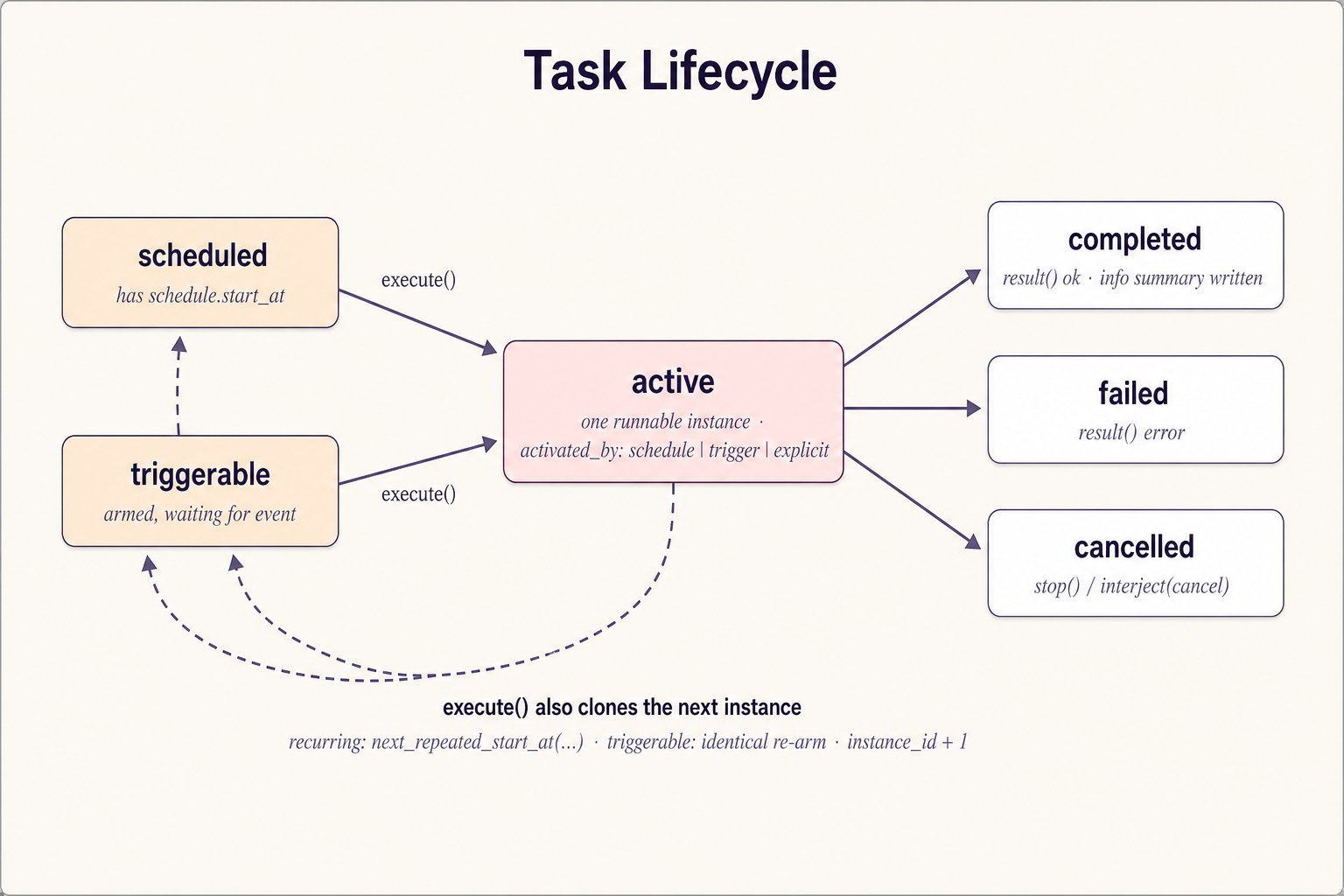 [`Status`](https://github.com/unifyai/unify/blob/main/unify/task_scheduler/types/status.py)
is a six-value enum: `scheduled`, `triggerable`, `active`, `completed`,
`cancelled`, `failed`. There is no separate FSM module — transitions are
enforced by the scheduler's validation funnel:
* Creation lands in `scheduled` (has `schedule.start_at`) or `triggerable`
(has `trigger`); writing `active` directly on create or update is
forbidden.
* Only `TaskScheduler.execute` moves a row to `active`, stamping
`activated_by` as it does.
* Terminal states come from the run itself:
[`ActiveTask.result()`](https://github.com/unifyai/unify/blob/main/unify/task_scheduler/active_task.py)
writes `completed` (plus an LLM-generated `info` summary) or `failed`;
`stop()` and cancel-classified interjections write `cancelled`.
**Re-arm happens at execute time, not completion time.** When `execute`
starts a `triggerable` task, it first clones an identical new `triggerable`
instance (so the trigger stays armed while the current instance runs), then
marks the current one `active`. Recurring scheduled tasks clone the next
instance with `schedule.start_at = next_repeated_start_at(...)` — and if
there is no next occurrence (a `count`/`until` boundary), no clone is made
and the series ends. See `_clone_task_instance` in
[`task_scheduler.py`](https://github.com/unifyai/unify/blob/main/unify/task_scheduler/task_scheduler.py).
## `TaskScheduler`: the manager
[`TaskScheduler`](https://github.com/unifyai/unify/blob/main/unify/task_scheduler/task_scheduler.py)
(extending the abstract contracts in
[`base.py`](https://github.com/unifyai/unify/blob/main/unify/task_scheduler/base.py))
is the manager the actor reaches through `primitives.tasks.*`. Its public
surface is deliberately small:
| Method | What it does |
| ---------------------------------------------------------- | ---------------------------------------------------------------------------------------------------------------------------------------------------------------- |
| `ask(text)` | Read-only questions, answered by an LLM tool loop over the internal query tools. Returns a `SteerableToolHandle`. |
| `update(text)` | Mutations via an LLM tool loop over the internal mutation tools. Returns a `SteerableToolHandle`. |
| `execute(task_id, *, trigger_attempt_token=None)` | "Start one runnable task instance and return its live handle." Unlike `ask`/`update`, this is **not** a tool loop — it returns the `ActiveTask` handle directly. |
| `create_task(name=..., description=..., destination=None)` | Thin non-LLM wrapper over row creation. |
Inside the `ask`/`update` loops, the LLM composes internal tools:
`_filter_tasks` (boolean expressions), `_search_tasks` (semantic vector
search), `_reduce` (aggregates), `_create_task`/`_create_tasks`,
`_update_task`, `_update_task_instance`, `_update_task_status`,
`_delete_task`, `_cancel_tasks`, and `_get_task_or_raise`. The update loop
also wires in `ContactManager.ask`, so "when Alice emails, text me" can
resolve *Alice* to a contact id without leaving the loop. When the caller
provides clarification queues, a `request_clarification` tool is injected
too — this is how ambiguous edits ("move it to 8" — a.m.? which task?)
bubble a question to the user instead of guessing.
Every write funnels through the same validators regardless of entry point:
schedule-XOR-trigger, `scheduled` requires `start_at`, `triggerable`
requires `trigger`, no direct `active` writes, and active rows resist most
mutation (`_ensure_not_active_task`). Prompts for the loops live in
[`prompt_builders.py`](https://github.com/unifyai/unify/blob/main/unify/task_scheduler/prompt_builders.py).
## Storage and team routing
All I/O goes through
[`TasksStore`](https://github.com/unifyai/unify/blob/main/unify/task_scheduler/storage.py),
which "centralises reads, writes, field management, and metrics." Four
contexts (all under the `Assistants` project) make up the task system's
durable state:
| Context | Role |
| -------------------------- | ----------------------------------------------------------------------------------------- |
| `Tasks` | The user-authored task rows — the scheduler's primary read/write surface. |
| `Tasks/Activations` | Machine-projected activation rows (when should what fire) — read-only inside the runtime. |
| `Tasks/Runs` | Durable run records, one per execution. |
| `Tasks/OutboundOperations` | Idempotency ledger for offline sends. |
Team scoping rides the platform-wide destination system: a task created
with `destination="team:"` is written under `Teams//Tasks` via
`ContextRegistry.write_root`, while reads federate across the personal root
plus every team the assistant belongs to (`ContextRegistry.read_roots`).
During a run, the task's destination is exported as the `TASK_DESTINATION`
environment variable so writes made *by* the run (secrets lookups, new
rows) inherit the task's scope.
## Activation: three lanes
[`Status`](https://github.com/unifyai/unify/blob/main/unify/task_scheduler/types/status.py)
is a six-value enum: `scheduled`, `triggerable`, `active`, `completed`,
`cancelled`, `failed`. There is no separate FSM module — transitions are
enforced by the scheduler's validation funnel:
* Creation lands in `scheduled` (has `schedule.start_at`) or `triggerable`
(has `trigger`); writing `active` directly on create or update is
forbidden.
* Only `TaskScheduler.execute` moves a row to `active`, stamping
`activated_by` as it does.
* Terminal states come from the run itself:
[`ActiveTask.result()`](https://github.com/unifyai/unify/blob/main/unify/task_scheduler/active_task.py)
writes `completed` (plus an LLM-generated `info` summary) or `failed`;
`stop()` and cancel-classified interjections write `cancelled`.
**Re-arm happens at execute time, not completion time.** When `execute`
starts a `triggerable` task, it first clones an identical new `triggerable`
instance (so the trigger stays armed while the current instance runs), then
marks the current one `active`. Recurring scheduled tasks clone the next
instance with `schedule.start_at = next_repeated_start_at(...)` — and if
there is no next occurrence (a `count`/`until` boundary), no clone is made
and the series ends. See `_clone_task_instance` in
[`task_scheduler.py`](https://github.com/unifyai/unify/blob/main/unify/task_scheduler/task_scheduler.py).
## `TaskScheduler`: the manager
[`TaskScheduler`](https://github.com/unifyai/unify/blob/main/unify/task_scheduler/task_scheduler.py)
(extending the abstract contracts in
[`base.py`](https://github.com/unifyai/unify/blob/main/unify/task_scheduler/base.py))
is the manager the actor reaches through `primitives.tasks.*`. Its public
surface is deliberately small:
| Method | What it does |
| ---------------------------------------------------------- | ---------------------------------------------------------------------------------------------------------------------------------------------------------------- |
| `ask(text)` | Read-only questions, answered by an LLM tool loop over the internal query tools. Returns a `SteerableToolHandle`. |
| `update(text)` | Mutations via an LLM tool loop over the internal mutation tools. Returns a `SteerableToolHandle`. |
| `execute(task_id, *, trigger_attempt_token=None)` | "Start one runnable task instance and return its live handle." Unlike `ask`/`update`, this is **not** a tool loop — it returns the `ActiveTask` handle directly. |
| `create_task(name=..., description=..., destination=None)` | Thin non-LLM wrapper over row creation. |
Inside the `ask`/`update` loops, the LLM composes internal tools:
`_filter_tasks` (boolean expressions), `_search_tasks` (semantic vector
search), `_reduce` (aggregates), `_create_task`/`_create_tasks`,
`_update_task`, `_update_task_instance`, `_update_task_status`,
`_delete_task`, `_cancel_tasks`, and `_get_task_or_raise`. The update loop
also wires in `ContactManager.ask`, so "when Alice emails, text me" can
resolve *Alice* to a contact id without leaving the loop. When the caller
provides clarification queues, a `request_clarification` tool is injected
too — this is how ambiguous edits ("move it to 8" — a.m.? which task?)
bubble a question to the user instead of guessing.
Every write funnels through the same validators regardless of entry point:
schedule-XOR-trigger, `scheduled` requires `start_at`, `triggerable`
requires `trigger`, no direct `active` writes, and active rows resist most
mutation (`_ensure_not_active_task`). Prompts for the loops live in
[`prompt_builders.py`](https://github.com/unifyai/unify/blob/main/unify/task_scheduler/prompt_builders.py).
## Storage and team routing
All I/O goes through
[`TasksStore`](https://github.com/unifyai/unify/blob/main/unify/task_scheduler/storage.py),
which "centralises reads, writes, field management, and metrics." Four
contexts (all under the `Assistants` project) make up the task system's
durable state:
| Context | Role |
| -------------------------- | ----------------------------------------------------------------------------------------- |
| `Tasks` | The user-authored task rows — the scheduler's primary read/write surface. |
| `Tasks/Activations` | Machine-projected activation rows (when should what fire) — read-only inside the runtime. |
| `Tasks/Runs` | Durable run records, one per execution. |
| `Tasks/OutboundOperations` | Idempotency ledger for offline sends. |
Team scoping rides the platform-wide destination system: a task created
with `destination="team:"` is written under `Teams//Tasks` via
`ContextRegistry.write_root`, while reads federate across the personal root
plus every team the assistant belongs to (`ContextRegistry.read_roots`).
During a run, the task's destination is exported as the `TASK_DESTINATION`
environment variable so writes made *by* the run (secrets lookups, new
rows) inherit the task's scope.
## Activation: three lanes
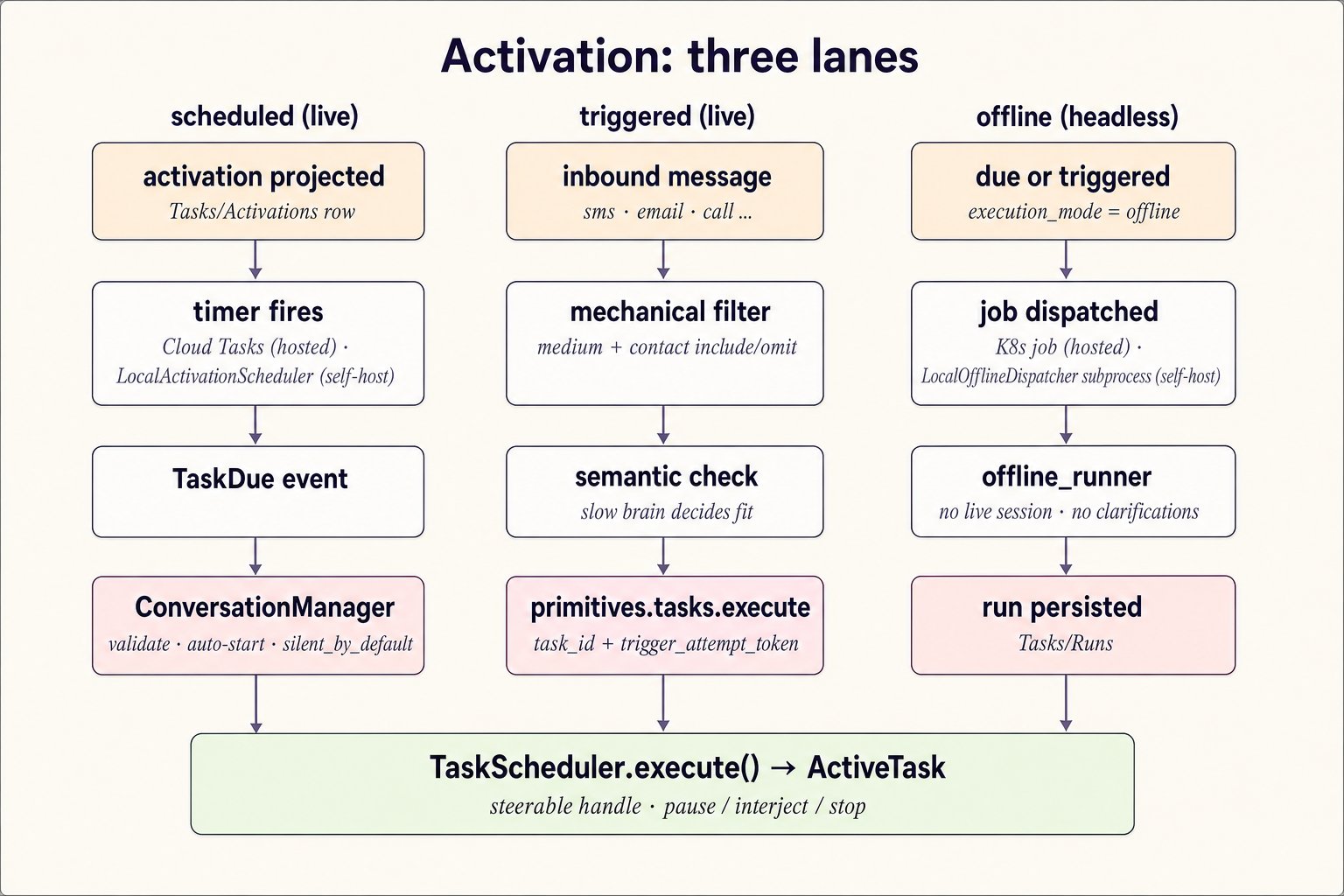 A task row does nothing by itself. Activation — deciding *now is the
moment* — arrives through one of three lanes, all converging on
`TaskScheduler.execute`.
### Scheduled (live)
Activations are projected into `Tasks/Activations`; a timer fires (Cloud
Tasks in the hosted deployment, or the in-process
[`LocalActivationScheduler`](https://github.com/unifyai/unify/blob/main/unify/task_scheduler/local_scheduler/scheduler.py)
for self-host — "an asyncio-timer supervisor that fires scheduled tasks
in-process", stateless across restarts, re-arming from wall-clock
`next_due_at` on boot). The timer publishes a
[`TaskDue`](https://github.com/unifyai/unify/blob/main/unify/conversation_manager/events.py)
event carrying `task_id`, `scheduled_for`, an `activation_revision`, and a
`visibility_policy` defaulting to `silent_by_default`.
The handler in
[`task_activation.py`](https://github.com/unifyai/unify/blob/main/unify/conversation_manager/domains/task_activation.py)
then: validates the delivery (`validate_task_due_activation` rejects stale
revisions, mismatched `scheduled_for`, and revoked team memberships),
records run provenance, and **auto-starts** the run via
`scheduler.execute(..., _activated_by=ActivatedBy.schedule)` — registering
the resulting handle in the ConversationManager's in-flight actions so the
user (and the brain) can steer it. The `silent_by_default` policy is what
produces the user-facing behavior documented in
[How tasks run](/tasks/running): the run's notification tells the brain to
"work silently unless you genuinely need the user." If the runtime was
asleep, the wake reason is replayed on startup so a `TaskDue` never falls
through the crack of a cold boot.
### Triggered (live)
Trigger matching is deliberately two-stage:
1. **Mechanical** — when an inbound communication arrives, the event
handlers call `_surface_trigger_task_candidates`, which lists armed
trigger activations for that medium and filters by the trigger's
`from_contact_ids` / `omit_contact_ids`. Cheap, deterministic, no LLM.
2. **Semantic** — surviving candidates are surfaced to the slow brain as a
notification: "Semantic judgement is still pending. Decide whether this
communication truly satisfies any candidate…" If the brain agrees, it
calls the exact `primitives.tasks.execute(task_id=...,
trigger_attempt_token="...")` line it was handed — the attempt token
keeps the triggering inbound attached to the run it caused.
So "when I get an email marked urgent, text me" costs nothing until an
email actually arrives, one cheap filter pass on arrival, and one semantic
judgment only for plausible matches.
### Offline (headless)
Tasks with `offline=True` skip the live session entirely. The hosted path
dispatches a job; self-host uses
[`LocalOfflineDispatcher`](https://github.com/unifyai/unify/blob/main/unify/task_scheduler/local_scheduler/offline_dispatcher.py),
which spawns `python -m unify.task_scheduler.offline_runner` as a
subprocess. The
[`offline_runner`](https://github.com/unifyai/unify/blob/main/unify/task_scheduler/offline_runner.py)
is "intentionally small and procedural": it reads its contract from
environment variables (built by
[`offline_runner_contract.py`](https://github.com/unifyai/unify/blob/main/unify/task_scheduler/offline_runner_contract.py),
shared with the hosted control plane), populates session details, runs
`TaskScheduler.execute` against a fresh `CodeActActor`, and persists the
terminal run state. Two behavioral differences from live runs: there is no
ConversationManager to wake, and clarifications are disabled — the run's
guidelines say plainly, "do not ask the user for live clarification."
## Execution: `ActiveTask`
Whichever lane fired, `execute` wraps the run in an
[`ActiveTask`](https://github.com/unifyai/unify/blob/main/unify/task_scheduler/active_task.py)
— "a thin wrapper around an actor-backed active plan handle, keeping the
corresponding Tasks row in sync." Under the hood it resolves an execution
delegate from
[`task_execution_context.py`](https://github.com/unifyai/unify/blob/main/unify/common/task_execution_context.py)
(the live ConversationManager's actor, or the offline runner's) and falls
back to a plain `actor.act(...)`.
`ActiveTask` is a full **steerable handle** — the same steering contract as
every other long-running operation in the runtime:
* `pause()` / `resume()` delegate straight to the actor.
* `interject(message)` first routes through `classify_steering_intent`, a
small LLM router labeling the interjection `cancel` / `continue` / other
— so "actually stop that" cancels the task row while "also include
refunds" flows into the running plan.
* `stop()` marks the row `cancelled`; `result()` marks it `completed`
(writing the `info` summary) or `failed`, and updates the `Tasks/Runs`
record either way.
## Symbolic entrypoints and offline certification
Agentic execution re-plans from the description every run. For recurring
work that has proven itself, the system can lock in a **symbolic
executor**: a stored function from the
[FunctionManager](https://github.com/unifyai/unify/blob/main/unify/function_manager/README.md)
whose `function_id` becomes the task's `entrypoint`.
The hook is wired at execution time: when a repeating or triggered agentic
task runs, `TaskScheduler._build_task_entrypoint_review` attaches a
post-run review context, and the actor (in
[`code_act_actor.py`](https://github.com/unifyai/unify/blob/main/unify/actor/code_act_actor.py))
gains two extra tools:
* `attach_entrypoint_to_recurring_task(function_id, rationale, equivalence_manifest, anti_oversimplification_checklist)`
— records the function as a **candidate** on future instances. It does
not change delivery; future runs still execute live, now via the stored
function.
* `submit_offline_certification_evidence(function_id, certification_evidence, promotion_rationale)`
— the gate to the headless lane. Promotion to `offline=True` demands a
structured evidence dossier: a `risk_classification` (only `safe_noop`,
`read_only`, and `idempotent_effectful` are promotable), input and
equivalence contracts, a managed-primitive contract (no ad-hoc
replacements of platform primitives), side-effect, idempotency, bounded
cost, failure, and observability contracts, plus six explicit boolean
attestations. The scheduler's `_offline_promotion_rejection_reasons`
enforces the checklist, and there are at most two revision attempts.
This is the machinery behind the user-facing claim that recurring work
"gets sharper with repetition" — and the reason a 3am headless run can be
trusted: nothing reaches the offline lane without a certified, bounded,
idempotent executor.
## Local vs hosted scheduling
The package cleanly splits *what fires* from *what decides when*:
* **Hosted:** the closed-source control plane owns timing (Cloud Tasks) and
job creation; the runtime uses a `NoopMaterializer` and just receives
`TaskDue` events.
* **Self-host / local:** [`settings.py`](https://github.com/unifyai/unify/blob/main/unify/task_scheduler/settings.py)
auto-detects the environment (`LOCAL_SCHEDULER_ENABLED`), and
[`materializer.py`](https://github.com/unifyai/unify/blob/main/unify/task_scheduler/local_scheduler/materializer.py)
builds the `LocalActivationScheduler` (polling `Tasks/Activations` on a
configurable interval, default 60s) plus the subprocess-based offline
dispatcher. Same events, same semantics, single daemon.
This is why the open-source install needs no Kubernetes and no cloud queue
to run scheduled and triggered tasks.
## Testing and extending
For deterministic tests and demos there is a storage-free drop-in,
[`SimulatedTaskScheduler`](https://github.com/unifyai/unify/blob/main/unify/task_scheduler/simulated.py),
with the same surface as the real manager. The test suite under
[`tests/task_scheduler/`](https://github.com/unifyai/unify/tree/main/tests/task_scheduler)
doubles as behavioral documentation — good entry points:
* [`test_trigger.py`](https://github.com/unifyai/unify/blob/main/tests/task_scheduler/test_trigger.py) — trigger creation, schedule×trigger exclusion, clone-on-execute re-arm.
* [`test_repetition.py`](https://github.com/unifyai/unify/blob/main/tests/task_scheduler/test_repetition.py) — `next_repeated_start_at`, recurrence cloning, offline promotion.
* [`test_execute.py`](https://github.com/unifyai/unify/blob/main/tests/task_scheduler/test_execute.py) — execution, provenance, trigger tokens, entrypoint review.
* [`test_local_scheduler_integration.py`](https://github.com/unifyai/unify/blob/main/tests/task_scheduler/test_local_scheduler_integration.py) — end-to-end local timer → `TaskDue`.
* [`test_offline_runner.py`](https://github.com/unifyai/unify/blob/main/tests/task_scheduler/test_offline_runner.py) — the headless lane's lifecycle.
If you're extending the system, the grain to follow: new *query/mutation*
capabilities belong as internal tools on the `ask`/`update` loops; new
*activation sources* belong as events handled in `task_activation.py`; new
*execution styles* belong behind the `entrypoint` field and the
certification gate — and everything durable belongs in the four `Tasks*`
contexts, never in process state.
A task row does nothing by itself. Activation — deciding *now is the
moment* — arrives through one of three lanes, all converging on
`TaskScheduler.execute`.
### Scheduled (live)
Activations are projected into `Tasks/Activations`; a timer fires (Cloud
Tasks in the hosted deployment, or the in-process
[`LocalActivationScheduler`](https://github.com/unifyai/unify/blob/main/unify/task_scheduler/local_scheduler/scheduler.py)
for self-host — "an asyncio-timer supervisor that fires scheduled tasks
in-process", stateless across restarts, re-arming from wall-clock
`next_due_at` on boot). The timer publishes a
[`TaskDue`](https://github.com/unifyai/unify/blob/main/unify/conversation_manager/events.py)
event carrying `task_id`, `scheduled_for`, an `activation_revision`, and a
`visibility_policy` defaulting to `silent_by_default`.
The handler in
[`task_activation.py`](https://github.com/unifyai/unify/blob/main/unify/conversation_manager/domains/task_activation.py)
then: validates the delivery (`validate_task_due_activation` rejects stale
revisions, mismatched `scheduled_for`, and revoked team memberships),
records run provenance, and **auto-starts** the run via
`scheduler.execute(..., _activated_by=ActivatedBy.schedule)` — registering
the resulting handle in the ConversationManager's in-flight actions so the
user (and the brain) can steer it. The `silent_by_default` policy is what
produces the user-facing behavior documented in
[How tasks run](/tasks/running): the run's notification tells the brain to
"work silently unless you genuinely need the user." If the runtime was
asleep, the wake reason is replayed on startup so a `TaskDue` never falls
through the crack of a cold boot.
### Triggered (live)
Trigger matching is deliberately two-stage:
1. **Mechanical** — when an inbound communication arrives, the event
handlers call `_surface_trigger_task_candidates`, which lists armed
trigger activations for that medium and filters by the trigger's
`from_contact_ids` / `omit_contact_ids`. Cheap, deterministic, no LLM.
2. **Semantic** — surviving candidates are surfaced to the slow brain as a
notification: "Semantic judgement is still pending. Decide whether this
communication truly satisfies any candidate…" If the brain agrees, it
calls the exact `primitives.tasks.execute(task_id=...,
trigger_attempt_token="...")` line it was handed — the attempt token
keeps the triggering inbound attached to the run it caused.
So "when I get an email marked urgent, text me" costs nothing until an
email actually arrives, one cheap filter pass on arrival, and one semantic
judgment only for plausible matches.
### Offline (headless)
Tasks with `offline=True` skip the live session entirely. The hosted path
dispatches a job; self-host uses
[`LocalOfflineDispatcher`](https://github.com/unifyai/unify/blob/main/unify/task_scheduler/local_scheduler/offline_dispatcher.py),
which spawns `python -m unify.task_scheduler.offline_runner` as a
subprocess. The
[`offline_runner`](https://github.com/unifyai/unify/blob/main/unify/task_scheduler/offline_runner.py)
is "intentionally small and procedural": it reads its contract from
environment variables (built by
[`offline_runner_contract.py`](https://github.com/unifyai/unify/blob/main/unify/task_scheduler/offline_runner_contract.py),
shared with the hosted control plane), populates session details, runs
`TaskScheduler.execute` against a fresh `CodeActActor`, and persists the
terminal run state. Two behavioral differences from live runs: there is no
ConversationManager to wake, and clarifications are disabled — the run's
guidelines say plainly, "do not ask the user for live clarification."
## Execution: `ActiveTask`
Whichever lane fired, `execute` wraps the run in an
[`ActiveTask`](https://github.com/unifyai/unify/blob/main/unify/task_scheduler/active_task.py)
— "a thin wrapper around an actor-backed active plan handle, keeping the
corresponding Tasks row in sync." Under the hood it resolves an execution
delegate from
[`task_execution_context.py`](https://github.com/unifyai/unify/blob/main/unify/common/task_execution_context.py)
(the live ConversationManager's actor, or the offline runner's) and falls
back to a plain `actor.act(...)`.
`ActiveTask` is a full **steerable handle** — the same steering contract as
every other long-running operation in the runtime:
* `pause()` / `resume()` delegate straight to the actor.
* `interject(message)` first routes through `classify_steering_intent`, a
small LLM router labeling the interjection `cancel` / `continue` / other
— so "actually stop that" cancels the task row while "also include
refunds" flows into the running plan.
* `stop()` marks the row `cancelled`; `result()` marks it `completed`
(writing the `info` summary) or `failed`, and updates the `Tasks/Runs`
record either way.
## Symbolic entrypoints and offline certification
Agentic execution re-plans from the description every run. For recurring
work that has proven itself, the system can lock in a **symbolic
executor**: a stored function from the
[FunctionManager](https://github.com/unifyai/unify/blob/main/unify/function_manager/README.md)
whose `function_id` becomes the task's `entrypoint`.
The hook is wired at execution time: when a repeating or triggered agentic
task runs, `TaskScheduler._build_task_entrypoint_review` attaches a
post-run review context, and the actor (in
[`code_act_actor.py`](https://github.com/unifyai/unify/blob/main/unify/actor/code_act_actor.py))
gains two extra tools:
* `attach_entrypoint_to_recurring_task(function_id, rationale, equivalence_manifest, anti_oversimplification_checklist)`
— records the function as a **candidate** on future instances. It does
not change delivery; future runs still execute live, now via the stored
function.
* `submit_offline_certification_evidence(function_id, certification_evidence, promotion_rationale)`
— the gate to the headless lane. Promotion to `offline=True` demands a
structured evidence dossier: a `risk_classification` (only `safe_noop`,
`read_only`, and `idempotent_effectful` are promotable), input and
equivalence contracts, a managed-primitive contract (no ad-hoc
replacements of platform primitives), side-effect, idempotency, bounded
cost, failure, and observability contracts, plus six explicit boolean
attestations. The scheduler's `_offline_promotion_rejection_reasons`
enforces the checklist, and there are at most two revision attempts.
This is the machinery behind the user-facing claim that recurring work
"gets sharper with repetition" — and the reason a 3am headless run can be
trusted: nothing reaches the offline lane without a certified, bounded,
idempotent executor.
## Local vs hosted scheduling
The package cleanly splits *what fires* from *what decides when*:
* **Hosted:** the closed-source control plane owns timing (Cloud Tasks) and
job creation; the runtime uses a `NoopMaterializer` and just receives
`TaskDue` events.
* **Self-host / local:** [`settings.py`](https://github.com/unifyai/unify/blob/main/unify/task_scheduler/settings.py)
auto-detects the environment (`LOCAL_SCHEDULER_ENABLED`), and
[`materializer.py`](https://github.com/unifyai/unify/blob/main/unify/task_scheduler/local_scheduler/materializer.py)
builds the `LocalActivationScheduler` (polling `Tasks/Activations` on a
configurable interval, default 60s) plus the subprocess-based offline
dispatcher. Same events, same semantics, single daemon.
This is why the open-source install needs no Kubernetes and no cloud queue
to run scheduled and triggered tasks.
## Testing and extending
For deterministic tests and demos there is a storage-free drop-in,
[`SimulatedTaskScheduler`](https://github.com/unifyai/unify/blob/main/unify/task_scheduler/simulated.py),
with the same surface as the real manager. The test suite under
[`tests/task_scheduler/`](https://github.com/unifyai/unify/tree/main/tests/task_scheduler)
doubles as behavioral documentation — good entry points:
* [`test_trigger.py`](https://github.com/unifyai/unify/blob/main/tests/task_scheduler/test_trigger.py) — trigger creation, schedule×trigger exclusion, clone-on-execute re-arm.
* [`test_repetition.py`](https://github.com/unifyai/unify/blob/main/tests/task_scheduler/test_repetition.py) — `next_repeated_start_at`, recurrence cloning, offline promotion.
* [`test_execute.py`](https://github.com/unifyai/unify/blob/main/tests/task_scheduler/test_execute.py) — execution, provenance, trigger tokens, entrypoint review.
* [`test_local_scheduler_integration.py`](https://github.com/unifyai/unify/blob/main/tests/task_scheduler/test_local_scheduler_integration.py) — end-to-end local timer → `TaskDue`.
* [`test_offline_runner.py`](https://github.com/unifyai/unify/blob/main/tests/task_scheduler/test_offline_runner.py) — the headless lane's lifecycle.
If you're extending the system, the grain to follow: new *query/mutation*
capabilities belong as internal tools on the `ask`/`update` loops; new
*activation sources* belong as events handled in `task_activation.py`; new
*execution styles* belong behind the `entrypoint` field and the
certification gate — and everything durable belongs in the four `Tasks*`
contexts, never in process state.