> ## Documentation Index
> Fetch the complete documentation index at: https://docs.unify.ai/llms.txt
> Use this file to discover all available pages before exploring further.
# Architecture
> How communication actually works in the open-source unify repo
Everything in the [Communication section](/communication/overview) is
implemented in the open-source
[`unifyai/unify`](https://github.com/unifyai/unify) repository. This
developer sub-section explains how it *actually works* — the packages,
classes, and contracts — for anyone reading, extending, or self-hosting the
code.
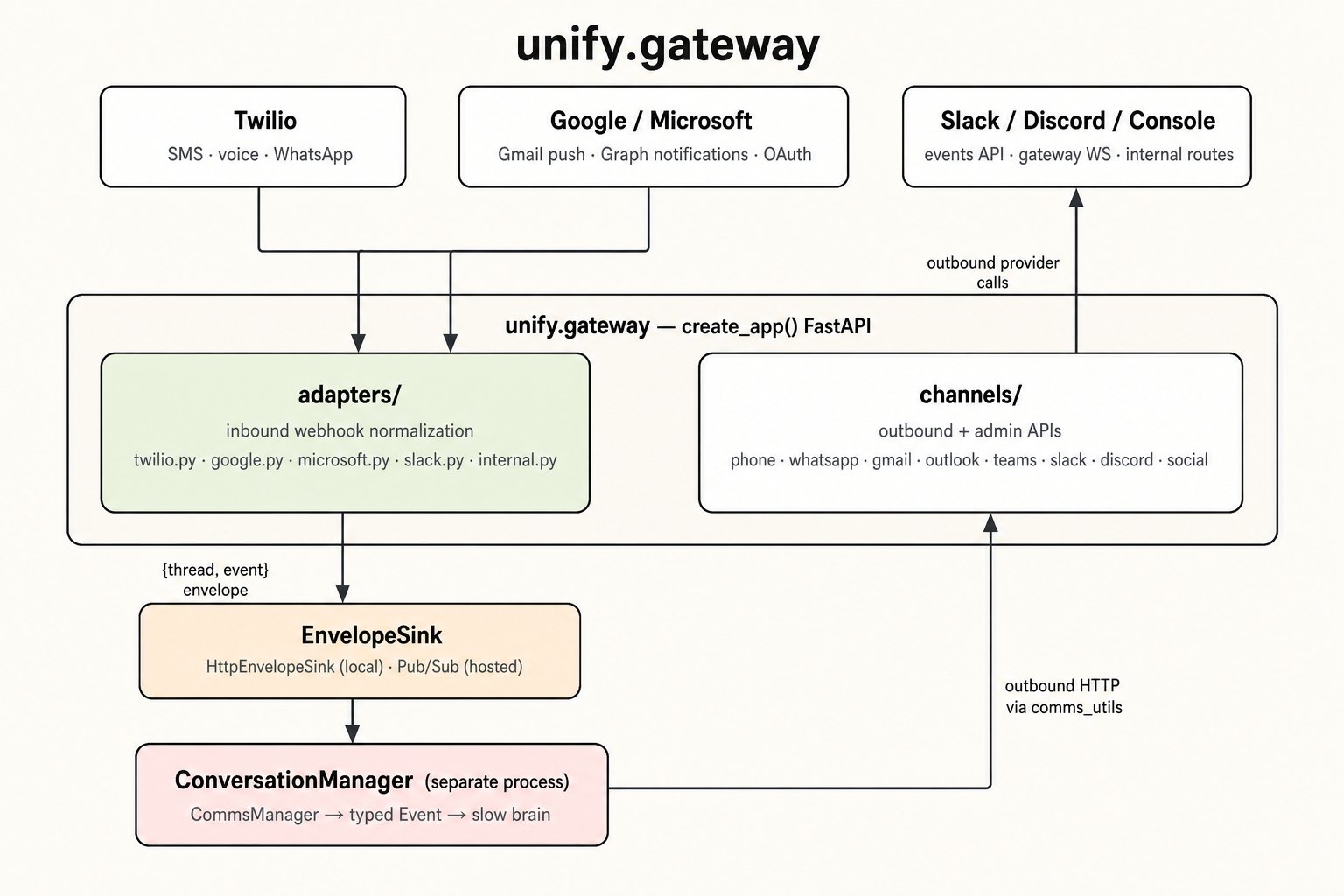
The communication stack is two cooperating pieces:
1. **The gateway** —
[`unify/gateway/`](https://github.com/unifyai/unify/tree/main/unify/gateway)
— a FastAPI application that is the HTTP edge between external providers
(Twilio, Google, Microsoft, Slack, Discord, the Console) and the
assistant runtime. It owns webhook parsing, route resolution, OAuth
callbacks, and outbound provider calls.
2. **The conversation runtime** —
[`unify/conversation_manager/`](https://github.com/unifyai/unify/tree/main/unify/conversation_manager)
— the `ConversationManager` process that consumes normalized events,
runs the reasoning loop (the "slow brain"), and sends outbound messages
back through the gateway via
[`unify/comms/primitives.py`](https://github.com/unifyai/unify/blob/main/unify/comms/primitives.py).
 ## The wire contract: envelopes
Every inbound event that crosses the gateway → runtime boundary is wrapped
in a `{thread, publish_timestamp, event}` **envelope**, defined in
[`unify/gateway/envelopes.py`](https://github.com/unifyai/unify/blob/main/unify/gateway/envelopes.py)
(the full catalogue of `thread` keys lives in `KNOWN_THREADS` there). The
`thread` is a routing key like `msg`, `whatsapp`, `email`, `unify_meet`, or
`call_answered`; the `event` is a channel-specific payload. This single
contract is what lets the same runtime code serve every channel.
## One codebase, two deployments
A design goal stated in the
[gateway README](https://github.com/unifyai/unify/blob/main/unify/gateway/README.md):
local self-hosted and hosted SaaS deployments run **the same gateway
code** — only the backend implementations differ. The seams are small
protocol interfaces carried on a `GatewayContext`
([`unify/gateway/context.py`](https://github.com/unifyai/unify/blob/main/unify/gateway/context.py)):
| Protocol | Local default | Hosted implementation |
| ------------------ | ------------------------------------------------------------------- | ------------------------------------------------------ |
| `EnvelopeSink` | `HttpEnvelopeSink` — POSTs envelopes to the runtime's local ingress | Pub/Sub publish to a per-assistant topic |
| `RuntimeActivator` | `LocalRuntimeActivator` (no-op; the runtime is already running) | `HostedRuntimeActivator` — wakes an idle assistant job |
| `Storage` | `LocalDiskStorage` for attachments | Cloud storage |
| `CredentialStore` | `EnvCredentialStore` — reads environment variables | Cloud secret backend |
The app factory is `create_app()` in
[`unify/gateway/app.py`](https://github.com/unifyai/unify/blob/main/unify/gateway/app.py).
The OSS path runs the stock app (`python -m unify.gateway serve`); the
hosted platform constructs its own app via
`create_app(extra_routers=..., extra_setup_hooks=...)` and mounts private
pieces on top of the same factory. Envelope sinks live in
[`unify/gateway/envelope_sink.py`](https://github.com/unifyai/unify/blob/main/unify/gateway/envelope_sink.py),
and ingress transports (the runtime's receiving side) in
[`unify/gateway/ingress.py`](https://github.com/unifyai/unify/blob/main/unify/gateway/ingress.py)
and siblings (`ingress_pubsub.py`, `ingress_inmemory.py`).
## The full round trip
Following one SMS end to end:
1. **Twilio → adapter.** Twilio POSTs to `twilio_sms_webhook` in
[`unify/gateway/adapters/twilio.py`](https://github.com/unifyai/unify/blob/main/unify/gateway/adapters/twilio.py).
The signature is validated, the target assistant is resolved (via
Orchestra's admin API), and the runtime is woken if idle.
2. **Adapter → envelope.** `publish_runtime_event()` in
[`unify/gateway/adapters/common.py`](https://github.com/unifyai/unify/blob/main/unify/gateway/adapters/common.py)
wraps the payload in an envelope with `thread="msg"` and hands it to the
`EnvelopeSink`.
3. **Envelope → typed event.** In the runtime, `CommsManager`
([`unify/conversation_manager/comms_manager.py`](https://github.com/unifyai/unify/blob/main/unify/conversation_manager/comms_manager.py))
maps the thread key through its `events_map` to a typed event —
`SMSReceived` from
[`unify/conversation_manager/events.py`](https://github.com/unifyai/unify/blob/main/unify/conversation_manager/events.py)
— resolving the sender to a contact along the way.
4. **Event → handler → brain.** The event is published on the in-process
broker; `ConversationManager.wait_for_events()` picks it up, the
registered handler logs it to transcripts and updates live state, and a
slow-brain turn is scheduled. Details in
[The conversation runtime](/communication/developers/conversation-manager).
5. **Brain → outbound.** If the brain decides to reply, its `send_sms` tool
delegates to `CommsPrimitives.send_sms`, which enforces the contact's
`should_respond` gate and POSTs to the gateway's `/phone/send-text`
channel endpoint — which calls Twilio. A matching `SMSSent` event is
published so the reply lands in transcripts too.
## Package map
| Package | Role | Key entry points |
| ------------------------------------------------------------------------------------------------------ | ----------------------------------- | ------------------------------------------------------------------- |
| [`unify/gateway/adapters/`](https://github.com/unifyai/unify/tree/main/unify/gateway/adapters) | Inbound webhook normalization | `twilio.py`, `google.py`, `microsoft.py`, `slack.py`, `internal.py` |
| [`unify/gateway/channels/`](https://github.com/unifyai/unify/tree/main/unify/gateway/channels) | Outbound + admin channel APIs | one sub-package per channel |
| [`unify/gateway/credentials/`](https://github.com/unifyai/unify/tree/main/unify/gateway/credentials) | Operator infrastructure credentials | `CredentialStore`, `EnvCredentialStore` |
| [`unify/conversation_manager/`](https://github.com/unifyai/unify/tree/main/unify/conversation_manager) | The live runtime | `ConversationManager`, `events.py`, `domains/` |
| [`unify/comms/`](https://github.com/unifyai/unify/tree/main/unify/comms) | Outbound send implementation | `CommsPrimitives` |
| [`unify/transcript_manager/`](https://github.com/unifyai/unify/tree/main/unify/transcript_manager) | Durable conversation record | `TranscriptManager` |
## Reading order
Channels vs adapters, per-channel modules, credentials, and how to add
a channel.
Events, mediums, the slow-brain loop, outbound sends, and transcripts.
The dual-brain call architecture — LiveKit, fillers, barge-in, and
hang-up semantics.
## The wire contract: envelopes
Every inbound event that crosses the gateway → runtime boundary is wrapped
in a `{thread, publish_timestamp, event}` **envelope**, defined in
[`unify/gateway/envelopes.py`](https://github.com/unifyai/unify/blob/main/unify/gateway/envelopes.py)
(the full catalogue of `thread` keys lives in `KNOWN_THREADS` there). The
`thread` is a routing key like `msg`, `whatsapp`, `email`, `unify_meet`, or
`call_answered`; the `event` is a channel-specific payload. This single
contract is what lets the same runtime code serve every channel.
## One codebase, two deployments
A design goal stated in the
[gateway README](https://github.com/unifyai/unify/blob/main/unify/gateway/README.md):
local self-hosted and hosted SaaS deployments run **the same gateway
code** — only the backend implementations differ. The seams are small
protocol interfaces carried on a `GatewayContext`
([`unify/gateway/context.py`](https://github.com/unifyai/unify/blob/main/unify/gateway/context.py)):
| Protocol | Local default | Hosted implementation |
| ------------------ | ------------------------------------------------------------------- | ------------------------------------------------------ |
| `EnvelopeSink` | `HttpEnvelopeSink` — POSTs envelopes to the runtime's local ingress | Pub/Sub publish to a per-assistant topic |
| `RuntimeActivator` | `LocalRuntimeActivator` (no-op; the runtime is already running) | `HostedRuntimeActivator` — wakes an idle assistant job |
| `Storage` | `LocalDiskStorage` for attachments | Cloud storage |
| `CredentialStore` | `EnvCredentialStore` — reads environment variables | Cloud secret backend |
The app factory is `create_app()` in
[`unify/gateway/app.py`](https://github.com/unifyai/unify/blob/main/unify/gateway/app.py).
The OSS path runs the stock app (`python -m unify.gateway serve`); the
hosted platform constructs its own app via
`create_app(extra_routers=..., extra_setup_hooks=...)` and mounts private
pieces on top of the same factory. Envelope sinks live in
[`unify/gateway/envelope_sink.py`](https://github.com/unifyai/unify/blob/main/unify/gateway/envelope_sink.py),
and ingress transports (the runtime's receiving side) in
[`unify/gateway/ingress.py`](https://github.com/unifyai/unify/blob/main/unify/gateway/ingress.py)
and siblings (`ingress_pubsub.py`, `ingress_inmemory.py`).
## The full round trip
Following one SMS end to end:
1. **Twilio → adapter.** Twilio POSTs to `twilio_sms_webhook` in
[`unify/gateway/adapters/twilio.py`](https://github.com/unifyai/unify/blob/main/unify/gateway/adapters/twilio.py).
The signature is validated, the target assistant is resolved (via
Orchestra's admin API), and the runtime is woken if idle.
2. **Adapter → envelope.** `publish_runtime_event()` in
[`unify/gateway/adapters/common.py`](https://github.com/unifyai/unify/blob/main/unify/gateway/adapters/common.py)
wraps the payload in an envelope with `thread="msg"` and hands it to the
`EnvelopeSink`.
3. **Envelope → typed event.** In the runtime, `CommsManager`
([`unify/conversation_manager/comms_manager.py`](https://github.com/unifyai/unify/blob/main/unify/conversation_manager/comms_manager.py))
maps the thread key through its `events_map` to a typed event —
`SMSReceived` from
[`unify/conversation_manager/events.py`](https://github.com/unifyai/unify/blob/main/unify/conversation_manager/events.py)
— resolving the sender to a contact along the way.
4. **Event → handler → brain.** The event is published on the in-process
broker; `ConversationManager.wait_for_events()` picks it up, the
registered handler logs it to transcripts and updates live state, and a
slow-brain turn is scheduled. Details in
[The conversation runtime](/communication/developers/conversation-manager).
5. **Brain → outbound.** If the brain decides to reply, its `send_sms` tool
delegates to `CommsPrimitives.send_sms`, which enforces the contact's
`should_respond` gate and POSTs to the gateway's `/phone/send-text`
channel endpoint — which calls Twilio. A matching `SMSSent` event is
published so the reply lands in transcripts too.
## Package map
| Package | Role | Key entry points |
| ------------------------------------------------------------------------------------------------------ | ----------------------------------- | ------------------------------------------------------------------- |
| [`unify/gateway/adapters/`](https://github.com/unifyai/unify/tree/main/unify/gateway/adapters) | Inbound webhook normalization | `twilio.py`, `google.py`, `microsoft.py`, `slack.py`, `internal.py` |
| [`unify/gateway/channels/`](https://github.com/unifyai/unify/tree/main/unify/gateway/channels) | Outbound + admin channel APIs | one sub-package per channel |
| [`unify/gateway/credentials/`](https://github.com/unifyai/unify/tree/main/unify/gateway/credentials) | Operator infrastructure credentials | `CredentialStore`, `EnvCredentialStore` |
| [`unify/conversation_manager/`](https://github.com/unifyai/unify/tree/main/unify/conversation_manager) | The live runtime | `ConversationManager`, `events.py`, `domains/` |
| [`unify/comms/`](https://github.com/unifyai/unify/tree/main/unify/comms) | Outbound send implementation | `CommsPrimitives` |
| [`unify/transcript_manager/`](https://github.com/unifyai/unify/tree/main/unify/transcript_manager) | Durable conversation record | `TranscriptManager` |
## Reading order
Channels vs adapters, per-channel modules, credentials, and how to add
a channel.
Events, mediums, the slow-brain loop, outbound sends, and transcripts.
The dual-brain call architecture — LiveKit, fillers, barge-in, and
hang-up semantics.